# Fibrous Surrealism
Woven Duality
---
## CHAPTER 1
### The Claim
A face is recognised before it is understood. The recognition arrives pre-verbally, ahead of any word for what is being seen, and it does not wait for permission. It is the oldest reflex a viewer has, and it is the one Fibrous Surrealism works on.
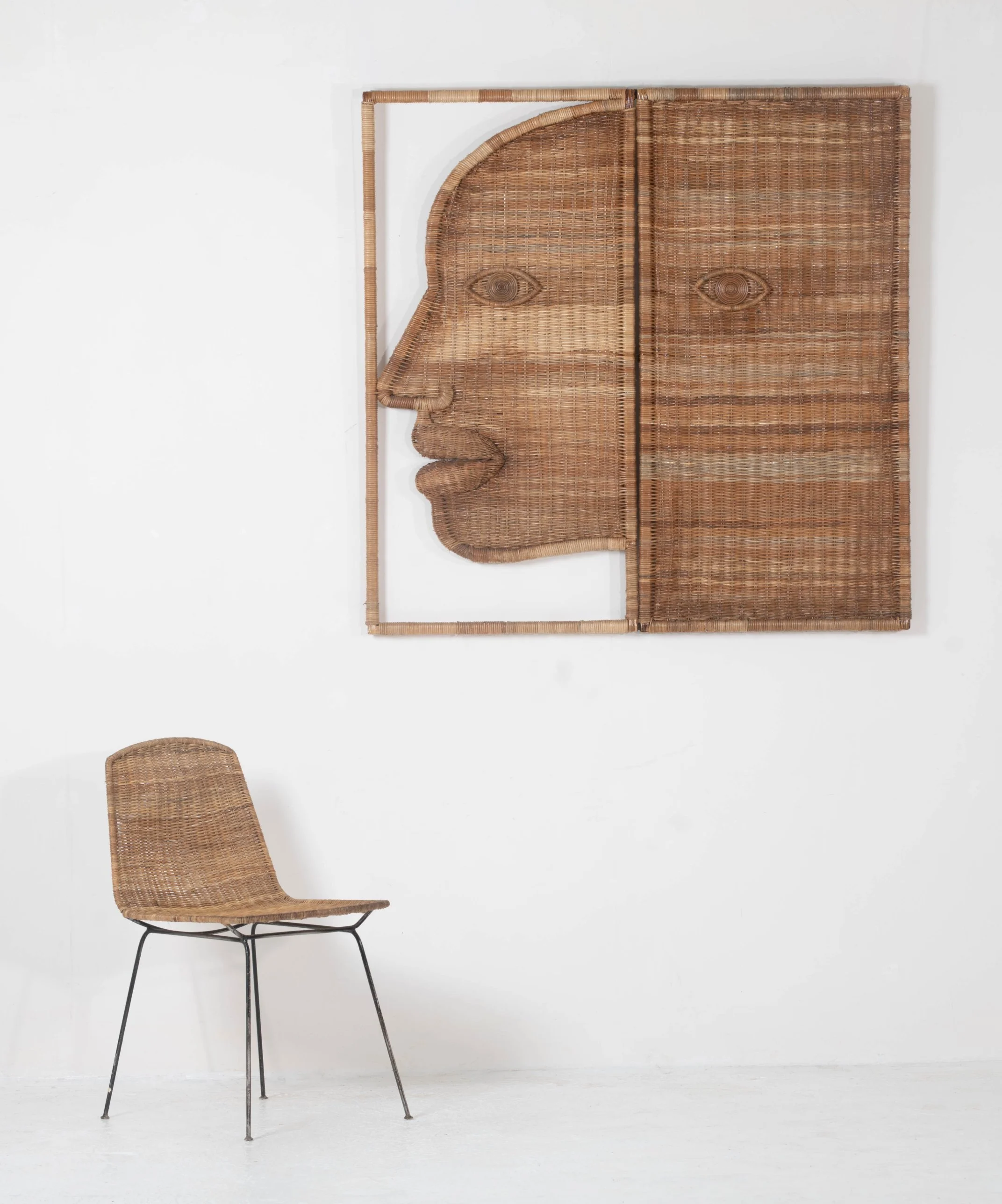
The movement makes a single claim: that the surreal can be produced by structure and not by imagery. Each work originates from a rigid steel armature, over which rattan and cane are applied under high tension, and a hard axial line divides the face across it. Two presences share a single construction, joined at a seam that is visible and does not resolve into one figure. The uncanny effect does not come from a distorted scene or a dream depicted. It comes from the object itself, in which the face is constructed, weave on weave, until it stands out of the material and looks back. To render the human feature in woven rattan is a difficult proposition. Each feature is built to stand out of the weave and to be read as a feature, and the viewer is left to judge whether it holds.
The name carries the argument. “Fibrous” is the material, taken literally. “Surrealism” is the claim about what the material can do. A movement needs a name for the same reason a claim needs a statement: so it can be tested and argued with.
The movement’s founding text, the manifesto issued in 2026 as a Codification of Form, sets out three principles. This book is their enlargement: it takes each in turn and sets out the reasoning behind it, the position it takes against what came before, and what it excludes. First, the Tensile Standard: rattan and cane applied under high tension to a rigid steel armature, the surface a visible record of that tension. Second, Axis Fracturing: a hard axial line that divides the face, which is whole only when divided. Third, Functional Infiltration: each work operates as an object in its environment without conceding its geometry. Together they are held, not resolved.
The strangeness in this book is located in the made thing, and the analysis will stay there. The aim is not to explain the mystery away, only to show where it comes from.
---
## CHAPTER 2
### From the Dealer’s Eye to the Weave
Fibrous Surrealism did not begin in an art school or a studio. It began in the trade. For more than a decade the artist dealt in antiques and vintage design, a working life spent in estate-sale back rooms and auction warehouses, among dry rot, worn finish and the slow decay of things people had stopped looking at. The trade taught him to read an object by its construction: how a joint was cut, where stress had run through a rail, what separated a crafted thing from a merely well-finished one. It taught him to look beneath the surface, and to distrust any claim an object could not back up with its own making.
That distrust became a total structural rejection. The artist abandoned the established liquidity of the British and European trade networks and relocated to a dense, humid province in the Philippines, where rattan is not a vintage category catalogued in a glossy portfolio but a living, unforgiving organism. There, working with a small team of weavers, he spent years learning the indigenous methods from the inside, as a maker learns a material and not as a dealer appraises it. The skill of the weavers he works with is essential to the work, and could not be replaced; the artistry, and the direction of every piece, is the artist’s own. Rattan had long held his devotion. Then came an epiphany: what he was making was art and not furniture, because it addressed an emotion deeper than use. From that moment the path was settled. The artist is British; the work is made in the Philippines.
The dealing years were shared. The artist and his wife worked the trade together, and the hunger that drove it, for the well-made and the rare, was built between them. When he turned to the work that became Fibrous Surrealism, she was there.
The first sign came in July 2025, in a workshop in the Philippines. Rattan was not being woven there but set onto commissioned doors to raise relief out of a flat panel. It was the material doing what the artist had long admired in thick paint: building form up out of a surface. Once seen, the possibility did not close.
The decisive step was small, literally. Experimenting with weaving faces on miniature frames, the artist found that features could be made from woven rattan itself: a brow, a cheek, the line of a mouth, each built up weave on weave until the wood stared back. The face was not drawn onto the material. It emerged from it.
The debt is to a material fact, not a subject. In the paintings the artist most admired, paint is used as substance: laid on thick, so that in raking light the flowers and grasses stand off the surface as relief. From them he took the idea that detail could be built from the material instead of drawn upon it. In rattan, the same principle held. A feature need not be added to the surface; the surface could rise into it. Good art places the viewer inside the work, and a surface that rises into its own features can do so.
Ten months of sustained work followed. The resulting pieces share a rule that would become the movement’s first principle: the surface is a visible record of how it was made. The features are built in the weave itself, and none is mere ornament.
This is the movement’s origin: the manifesto came after the findings, which were made by hand.
The movement was not announced and then made. The work was made first, from a background in objects and not in art movements, and the name followed.
---
## CHAPTER 3
### Lineage and Difference
Fibrous Surrealism enters a crowded room and says so. It borrows from two histories and belongs to neither.
From Surrealism it takes the uncanny object. Meret Oppenheim’s fur-covered cup (1936) made a household thing disturbing by changing its surface alone. Arcimboldo, whom the Surrealists prized, had built heads from fruit, flowers and books. Fibrous Surrealism inherits the composite face and then refuses the composite: its face is not assembled from other things. Its surface is rattan and cane throughout, laid over one armature, and the surface is the face.
From fibre art it takes its standing. MoMA’s Wall Hangings (1969), described as the first major art exhibition of fibre, argued that woven work belongs to the world of art, with Abakanowicz, Hicks and Tawney among its artists. Fibrous Surrealism treats that argument as won and asks a different question: not whether weaving is art, but what a woven face can say. Rattan has been shown at the Metropolitan Museum before, in Sopheap Pich’s open-weave sculptures of 2013, where the figure is an open weave that space passes through. Here the weave continues over weave, and the face is an interpretation, not a likeness.
Three questions mark the difference. Fibre art asks what textile can be. Surrealism asks what an object becomes under the unconscious. Fibrous Surrealism asks what happens when a face is divided along a hard axis: held, not resolved.
---
## CHAPTER 4
### The Tensile Standard
Every work begins as structure. It originates from a rigid steel armature, and the rattan and cane that form its surface are applied to it under high tension. The first principle concerns what that tension is for.
Rattan is a material with a habit. It bends, and left alone it relaxes into the arc that has made it the fibre of domestic comfort: the chair back, the basket, the screen. Almost every tradition that works it begins by accepting that habit and shaping it into the curve. The movement takes the opposite position. It treats the curve as a default to be refused, not a nature to be respected. Where the work curves, the curve is drawn: a line set by the maker and held under tension, not one the fibre relaxed into. Under tension the plane is forced flat and the corner is rendered sharp. The material is made to hold a geometry it would not choose.
This changes what the surface means. In a soft object the surface is the outcome of the material’s own tendencies, and the maker’s labour disappears into the ease. Here the surface is evidence of a contest. It records, strand by strand, a force applied and a force resisted, and the viewer can read the contest in the work. That is the sense in which the manifesto says the tension is the artifact. What the work exhibits is not a finished image but the record of how the fibre was held.
The armature is part of that record, and it is stated, not concealed. It carries the load. The fibre makes the surface, and the features of the face are built in that surface, weave on weave. This is also why the face is an interpretation and not a likeness. A likeness is assembled from outside, by copying. Here the features are what the tension and the weave produce, and they are read as features because they stand out of the ground that holds them.
Three things fail this principle. A concealed build fails it, because the record is the point. A relaxed curve fails it, because the contest was never fought. Fibre laid as decoration over a form decided elsewhere fails it, because the surface then records nothing but ornament.
The principle also separates the movement from the tradition it takes its standing from. Fibre art won the argument that woven work is art, often by embracing softness, drape and the irregularity of cloth. The Tensile Standard keeps the standing and refuses the softness. Its claim is a claim about authority: a material may be argued with, and the argument can be left in plain view.
---
## CHAPTER 5
### Axis Fracturing
The second principle concerns what the structure is built to do to a face. A hard axial line divides each work, and the line is built into the armature, so the division is structural. It is not a crack and it is not a drawing. Across the axis the face is dislocated: its features are separated across the line and, in multi-panel works, scattered across independent panels.
The face is chosen because it is the form least tolerated divided. A landscape or an object can be cut without protest, and the viewer supplies the missing part and moves on. Faces are read as wholes, quickly and without deciding to, so a divided face puts that habit to work in a way a divided still life cannot.
This is not the Surrealist dream picture, which sends the viewer elsewhere, into a scene that cannot exist. The manifesto’s phrase is dream logic held in rigid form. The strangeness is not imported by an image of something impossible. It is produced by geometry, an axis and a dislocation, in a material a hand can touch. The impossible thing is in the room. The uncanny does not depend on distance from the real. It depends on how close the real has been brought.
The axis fractures, and the seam holds. These are not rival terms. Fracturing is the act that divides the face. The seam is where the work keeps the division in view and refuses to close it. The result is a face that is whole only when divided: two presences sharing one construction, structurally incapable of being singular, with the work declining to choose between them. A divided face that is only a collage of two images fails the principle, because in a collage the pieces were whole before they were joined.
This is also where the movement’s use of the pre-verbal face belongs. Before there is a word for what is seen, there is a face. The recognition arrives ahead of the language that would describe it (a woman, a stranger, someone watching), and by the time the words come the recognition has already happened. The axis works on that moment and keeps it open. Two certainties are held together: this is applied material, and this is looking back. Neither cancels the other. The manifesto holds that the viewer feels the break. The book records the claim and leaves the verdict to the viewer, who may examine the face for as long as they choose, feature by feature, with nothing concealed.
Nothing in this asks for belief. The face is not claimed to be a spirit, a vision or a message. It is claimed to be recognised, and the recognition is the event.
---
## CHAPTER 6
### Functional Infiltration
The third principle begins with a refusal. The work rejects passive observation, the condition in which an art object is kept at a distance, behind a rope or on a plinth, to be admired and not used. Whether it appears as a freestanding totem, a directional light source or an open relief panel, each object operates as a functional apparatus within its environment. It stands in the space, it gives light, and in some works it bears a body.
The refusal has a limit, and the limit is the movement’s position against design. The modern tradition of functional objects holds that form follows function: the use settles the shape, and comfort and ergonomics govern the geometry. Fibrous Surrealism inverts the order. No geometric integrity is sacrificed for ergonomics or comfort. Function infiltrates the work and never governs its form, and use is admitted only on the work’s terms.
Where the line falls is decided by the face, not the function. A chair with a face added to it is furniture: remove the face and the chair remains. In a work of this movement the same removal leaves nothing, because the face and the object are one build. If an object remains, the work is design. If nothing remains, it is art that operates.
The Surrealist object often made a household thing strange. Here the household thing is kept, and the strangeness does the work. The same position answers the old line between art and craft, which sorted objects by whether they could be used. This movement does not sort by use. A work may be sat upon or may give light, and by this test it remains art.
Presentation follows. These works are shown as sculpture, photographed as sculpture and addressed as sculpture first. Their operation is a condition of the work and not its argument.
The manifesto’s formula for what results is exact: mathematical calculation executed in a warm, cellular medium. The apparatus is precise and the material is not. The work holds both and resolves neither: held, not resolved.
---
## CHAPTER 7
### Five Works
Five works are read here against the three principles. They are not a survey. Each is chosen because one principle is easiest to see in it.
Becoming Form: the Tensile Standard. A freestanding head, half woven face and half fine vertical ribs. The face is not finished off from the structure; it rises out of it, and the ribbed half shows the ground it rises from. The structure is read as plainly as the surface, and form is caught in the act of arriving.
Witness Diptych: Axis Fracturing. Two panels meet on a central axis, each carrying half a face that answers the other across the line. The halves mirror one another without matching: brow, nostril and mouth sit slightly off the axis. Neither half is the original, and neither is the reflection. The format makes the claim literal: identity witnessing itself, structurally incapable of being singular.
Split Reckoning: the axis and the seam. A single wall work, read as one: its two panels are joined along the axis, and one face is divided down that line. The axis does the dividing, and the seam holds what is divided. The reckoning is internal: a self examining the line where it was joined to itself.
The Supplicant: Functional Infiltration. A chaise longue with faces built into it. The chaise is the most domestic of forms, made for comfort, and here comfort is not allowed to govern the geometry. The faces are not set into the chaise as separate things; they belong to the same build. The title names a posture of asking, and the object holds that posture without comment.
The Discipline of Two: the principles at scale. The largest and most exacting work of the first collection, a three-panel screen 183 centimetres square. Across its three panels a head turns from profile to full face and opens into a field of vertical ribs. Its delivery is clinical, the most refined the movement has produced, and it is still unresolved in what it holds.
Five works, three principles: the structure is stated, the axis divides, the object operates, and the face is held, not resolved.
---
## CHAPTER 8
### Significance
The movement makes a claim about what a self is, and it makes the claim with a material, not an argument. A face divided along an axis and held at a seam, from a structure the viewer can see, says that identity is plural by nature. Two presences share one source and are not merged. This is not two things in conflict. It is one identity that was never built to be singular, and the work holds it in the open, where the viewer can check it.
The claim reaches into three older conversations. To Surrealism, it offers the uncanny in a single construction: a face that is the object itself. To fibre art, it offers a subject. That tradition won the argument that weaving is art, and this one asks what a woven face can say. To the old line between art and craft, it offers a working answer: use may remain, and the face decides.
To the viewer it offers a recognition that arrives first and an understanding that may follow. The face is seen before it is explained, and the explanation, when it comes, does not remove it.
The movement is nascent, and it shows. The first collection is an inception, not a verdict, and the vocabulary is still forming around the work. The movement remains inchoate in the way its subject is: a form caught in the act of arriving, a question held open and not closed.
That is the significance of Fibrous Surrealism: a self shown as plural, built in plain view, and recognised before it is named.
---
## ORDER OF MAKING
The works were made in overlap and in bursts, without a log. The dates below are approximate markers, not measurements.
19 July 2025. In a workshop in the Philippines, the artist sees rattan applied, not woven, to raise relief on commissioned doors. The material’s capacity to build form becomes clear to him.
Late 2025. The first weaving of faces, on miniature frames. The artist finds that human features can be made from woven rattan itself.
From late 2025. About ten months of sustained work, in which the first collection takes shape.
Before March 2026. The first works, among them a table lamp and a standing totem, each take about six weeks.
16 March 2026. Work begins on Witness Diptych, two panels meeting on a central axis.
2 April 2026. Work begins on Split Reckoning, a wall work 120 centimetres square, its two panels joined on the axis. It takes about ten weeks.
By June 2026. With the first works already made, the name Fibrous Surrealism is adopted for them and its domain names are registered.
Early July 2026. Work begins on The Supplicant, a chaise longue. It takes about two months.
By 4 July 2026. Witness Diptych is complete and hung, awaiting photography.
12 July 2026. Work begins on The Discipline of Two, the largest work of the first collection, a three-panel screen 183 centimetres square.
18 July 2026. Work begins on Becoming Form, a freestanding head.
20 September 2026. Becoming Form, a freestanding head 160 centimetres high, is photographed.
October 2026. The Discipline of Two is completed, and the movement statement is finished.
---
## ACKNOWLEDGEMENT
The years of dealing in antiques were the artist’s and his wife’s together, and she was there when the work began. The work, and this book, would not exist without her support.